Markets hate uncertainty. When conflict breaks out, such as the current tensions between the US, Israel, and Iran, investors often flee to “safe havens” like gold or USD. This causes a temporary drop in equity prices. For the long-term investor, this is a “Geopolitical Discount.” You are essentially buying the same high-quality companies you liked six months ago, but at a lower price point. History shows that markets typically “price in” the worst-case scenario early; once the situation stabilises or a clear path forward emerges, prices often snap back quickly.
The current volatility is “noise.” The fundamental value of the companies within a portfolio has not disappeared because of a conflict. By investing into a portfolio now, you are exercising prudence, patience and forward-thinking.
A graph of the MSCI from 2021 to March 2026 is shown below – it illustrates how the market drops and how it recovers following times of conflict.
The “Hidden” Price of Safety
When a client chooses to stay in cash or a “safe haven” (like a low-interest savings account) during a market dip, you might feel that you are avoiding risk, however, the opportunity cost is the recovery growth that you could forfeit.
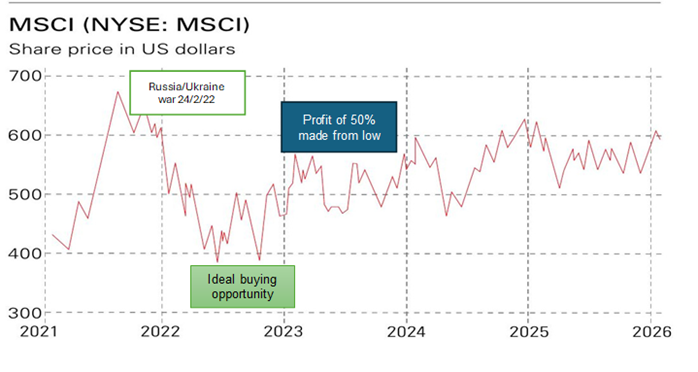
Key Takeaway: The “danger zone” is almost always the best time to accumulate assets. By the time the news feels “safe” again, the prices have already moved higher
The Current US/Israel/Iran Situation
Geopolitical conflicts often cause a “knee-jerk” price reduction. Currently, prices are lower because the market is pricing in “worst-case scenarios.”
During times of war the natural human reaction is fear, however, for the disciplined investor, these moments often represent the most significant opportunities for long-term growth
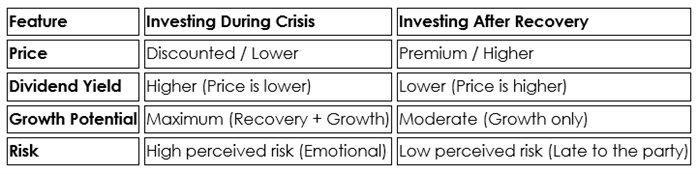
Buying at a Discount: For a long-term investor, a war-induced dip is essentially a “sale.” You are acquiring more units of high-quality, companies at a lower cost.
Market Resilience: Historically, the S&P 500 and the JSE recover from geopolitical shocks within 1 to 3 months on average. For example, following the October 7, 2023, attacks, many global indices were actually higher three months later as the market shifted focus back to economic fundamentals like interest rates and corporate earnings
Why “Now” is the Ideal Time
Investing when prices are low—during a “correction”—is one of the most effective ways to build wealth.
The Current Mid-East Tensions (2024–2026)
Market Action: Recent volatility in the JSE reflecting fears of escalation.
The Opportunity: Current price levels represent a significantly lower entry point than the highs seen in previous quarters.

- The biggest risk in a volatile market isn’t a price drop—it is missing the recovery.
- Missing the Best Days: Historically, the “best” days in the market (the biggest gains) often happen immediately following the “worst” days. If you sit on the sidelines in cash, you risk missing the rapid price appreciation that occurs the moment the geopolitical tension de-escalates.
- Long-Term Horizon: For an investor with a 5- to 10-year view, a 2-week or 2-month conflict is a minor blip on a chart. The focus should remain on the compounding power of the underlying businesses.
- Investing now is not a bet on war; it is a bet on human resilience and economic recovery.
- Buying while others are fearful is the hallmark of professional wealth management
- We recommend maintaining—or increasing—allocations now to capture the long-term upside when stability returns
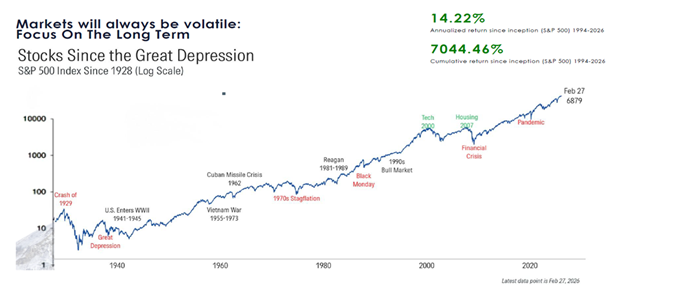
- The graph below show the movement of the S& P index from 1928 to date, which shows how the market recovers following market shocks.