South Africa’s stock market, as represented by the JSE All Share, is on track to have one of its best years on record in 2025.
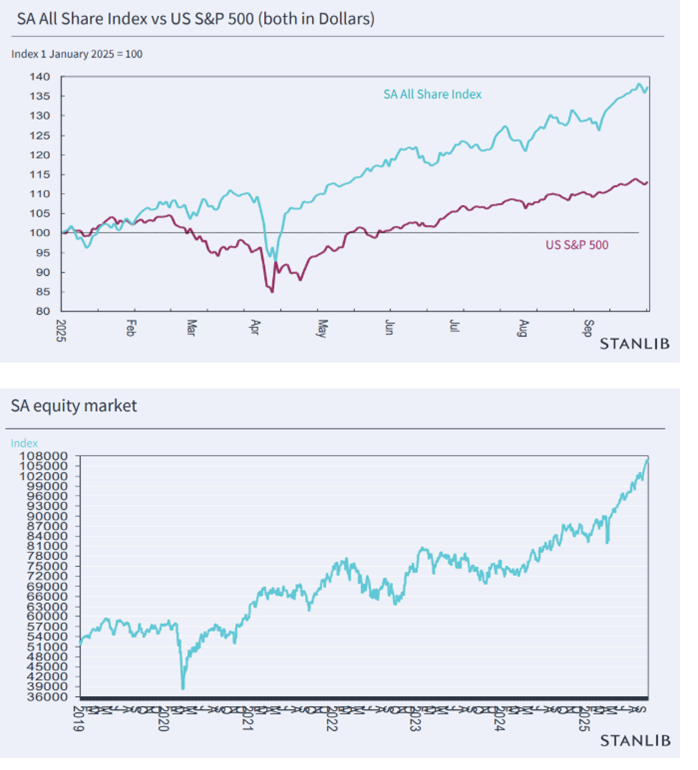
The All Share Index has returned close to 40% in dollar terms, which is significantly above the mid-teens return for the US benchmark S&P500 index.
This is quite remarkable considering the elevated uncertainty and volatility in financial markets so far in 2025, which typically leads to investors fleeing emerging markets, such as South Africa.
Amid increased uncertainty, investors tend to move capital towards safer assets in developed economies, particularly the US stock market and Treasury bills.
However, this has not been the case in 2025 as investors have become increasingly concerned about the United States’ financial health and the Trump administration’s efforts to reshape global trade.
This has also resulted in the dollar weakening meaningfully in 2025, with the greenback down over 9% for the year.
In turn, this has resulted in the rand strengthening versus the dollar, which has boosted the return of the JSE All Share in dollar terms.
The local index has also been boosted by a surge in precious metal prices, with mining stocks soaring amid elevated gold and platinum prices.
While South Africa is no longer a major producer of gold, there are still notable gold miners listed on the local exchange, such as GoldFields, AngloGold Ashanti, Harmony Gold, and DRDGold.
The country is much more prominent when it comes to the production of platinum, with South Africa being the largest producer of platinum group metals (PGMs).
As a result, JSE-listed miners such as Sibanye Stillwater, Impala Platinum, Valterra (formerly Amplats), and Northam Platinum have had a strong 2025.
The performance of these mining stocks has boosted the JSE’s returns and is expected to bolster the government’s tax revenue.
The graphs below show the performance of the JSE All Share versus the S&P500 in 2025 and over the past six years, courtesy of Stanlib chief economist Kevin Lings.
South African economy is still stagnant
The performance of the JSE is made more remarkable by the fact that South Africa’s economy remains stagnant, growing at less than 1% a year for the past decade.
Chief investment strategist at Old Mutual’s Symmetry, Izak Odendaal, explained that this does not mean the South African economy is performing well, as the JSE’s performance does not reflect local economic activity.
The performance of the mining companies driving the All Share index higher is not due to improved operating conditions in South Africa, but purely because of global factors.
Furthermore, South Africa is unlikely to benefit greatly in terms of economic growth from an elevated gold price, as the country is a relatively small producer of the precious metal.
Odendaal also said that negative news sells, with very little positive news about the local economy being shared by the press.
The news doesn’t give the full picture. Negative or shocking headlines will always grab more attention, and attention sells newspapers.
“Yet many things still work well every day in a R7 trillion per year economy of 60 million people. People go to work, children go to school, families celebrate and mourn together, communities gather in churches and mosques and so on,” Odendaal said.
“Millions of daily interactions and transactions go unreported because they are unremarkable, but they are also the bedrock of the economy and society.”
This is coupled with the fact that the JSE does not reflect the local economy, with a few JSE-listed companies relying only on South Africa for their revenue and growth.
Many of the largest companies on the exchange have significant operations outside of the country and generate most of their profits offshore.
Of the top 10 companies by market value on the JSE, only Capitec and FirstRand truly count as local companies when considering where most of their revenue is generated.
The biggest property company on the JSE by market value, NEPI Rockcastle, runs an Eastern European real estate portfolio.
“The hodgepodge of local and international firms listed on the JSE is collectively growing profits at a steady pace despite a lacklustre South African economy,” Odendaal said.