Morningstar’s latest report shares lessons in investor behaviour from the April market selloff.
Financial advisers play a pivotal role in helping clients to ride out market shocks and avoid making poor financial decisions in their wake, according to Morningstar’s 2026 Outlook.
Behavioural traps can lead investors to make the wrong decisions, at the worst time, undermining their long-term investment outcomes in the process. This year was a case in point.
The report shared how investors who pulled their investments from the market (either to reinvest three months later, or leave these funds in cash) in April, after US President Donald Trump’s tariff announcements, subsequently missed out on strong gains (see graph below). Investors’ collective action resulted in a 15% to 20% selloff in US equities that month.
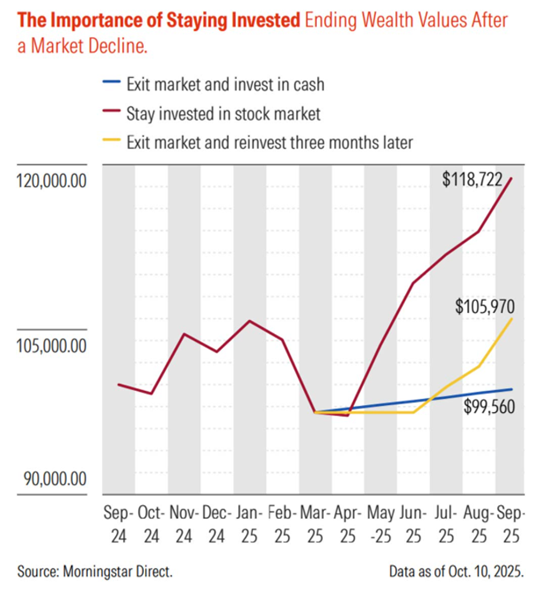
‘If equity fair values move proportionally with long-term earnings, and earnings likewise with GDP, then that selloff represented a substantial overreaction, even under the worst-case scenario,’ said Morningstar.
Uncertainty may be part of the investment process, but unfortunately, ‘humans are naturally wired to act at the wrong time,’ said Morningstar.
‘During these periods, advisers play a key role in helping clients avoid behavioural mistakes, in part by guiding their attention to what truly matters.
‘Research from Morningstar’s Behavioural Insights Group found that, amid tariff uncertainty, the most common support clients wanted from advisers was market education: something many advisers provided. That education helped, as advisers said clients were more comfortable enduring volatility when given historical context and long-term data.’
Client education is vital
According to the report, market education extends beyond providing information about current volatility, which on its own may just be noise. Rather, advisers should try to give investors the knowledge they need to make sense of events.
Further, it ‘offers an opportunity for advisers to shift the focus from short-term headlines toward long-term investment principles, emphasising full market cycles and the value of staying invested over time’.
Education, said Morningstar, connects information to fundamental principles, underlying mechanisms and the broader context. In educating clients in this way, advisers help to transform clients ‘from seekers of quick fixes into well-informed investors guided by understanding and meaningful action’.
The report emphasised that advisers should try to educate clients in this way before and during periods of inevitable market turbulence.
Sit tight and don’t overreact
The report researchers shared several factors they’ll be watching in 2026.
‘We’ll be watching developments in policy, the Fed, and other areas closely… Interestingly, the factor most likely to shape long-term macroeconomic outcomes in 2026 – whether positively or negatively – is technological rather than political,’ it said.
AI in particular ‘has the potential to drive sustained productivity growth, which could lift GDP and influence interest rates and other key economic variables. However, the rapid expansion of AI infrastructure, especially in the absence of clear monetisation strategies, introduces downside risk.’
It believes that if investor sentiment shifts, the resulting pullback could have significant macroeconomic implications.
‘Time-tested investment principles’
‘Markets are unpredictable and 2026 will test investor discipline in ways both familiar and new… we urge investors not to overreact to headlines. In particular, media coverage and popular perceptions often exaggerate the impact of politics on the economy and markets,’ stated the report.
To avoid impulsive decision-making in 2026, it advised investors to ‘recognise biases, prepare for a wide range of economic outcomes in 2026 and ground investment decisions in a disciplined, time-tested framework’, particularly when navigating these episodes.
The report shared the Morningstar investment team’s approach.
Avoid overreacting to headlines. ‘Don’t sell assets during market downturns. Periods of heightened uncertainty often lead to sharp recovery rallies: missing these can significantly affect long-term investment outcomes,’ it said, adding that missing the best 10 market days over the past 25 years would have more than halved the holding period return.
‘Rebalance and stay committed to your strategy.’ During headline-driven shocks, we rebalance portfolios back to target allocations. Rebalancing – selling winners and buying losers – is countercyclical and historically adds value during volatile periods.
Seek opportunities where markets have overcorrected relative to fundamentals. ‘Elevated uncertainty can lead investors to discount certain assets more than fundamentals justify,’ it said. Morningstar said it ‘rigorously analyses’ the impact on corporate and economic fundamentals, taking time to build conviction before acting.