Trying to time the markets with Foreign Currency trades is typically a worse approach than buying and holding due to how inherently unpredictable and volatile currency markets are. Trading in the short term requires predicting price movements, which is highly challenging because of the rapid changes caused by Geopolitical events, market sentiment and the latest economic data. More frequent trades also attract more fees which can eat into profits over time. In contrast a buy and hold strategy benefits from long-term growth as well as lowering costs through less fees and removes the stress of having to constantly monitor the markets. This results in a steadier and more cost-effective approach for many investors
Firstly, forex markets are notoriously unpredictable and are influenced by a complex mix of factors, including interest rates, inflation, geopolitical events, economic data, and central bank policies. These variables are often impossible to forecast with much accuracy, even for seasoned traders. For example, unexpected events like political instability or natural disasters can cause sudden, dramatic shifts in currency values, rendering technical analysis or predictive models unreliable. This highlights the value of the buy and hold approach over trying to time a volatile and unpredictable market.
Secondly, the costs associated with frequent forex trading are significant. Timing the market usually involves many transactions, each incurring spreads (the difference between bid and ask prices), commissions, and sometimes swap fees for holding positions overnight. In forex, spreads can be particularly wide for less liquid currency pairs, eroding potential profits. For instance, a trader attempting to time trades on a daily or weekly basis may lose a significant portion of gains to these costs, especially in volatile markets. Conversely, a buy-and-hold approach keeps transaction numbers to a minimum, reducing accumulated fees. By purchasing a currency and keeping it, an investor pays transaction costs only once or twice (at entry and exit), preserving more of their capital for long-term growth.
Third, the psychological toll of market timing cannot be understated. Constantly monitoring exchange rates, analysing news, and making rapid trading decisions creates stress and emotional fatigue. This often leads to impulsive or fear-driven decisions, such as selling during a dip or chasing a rally, which can result in losses. A buy-and-hold strategy, by contrast, promotes discipline and patience. Investors who hold currencies for years are less affected by daily volatility, allowing them to avoid emotional pitfalls and stick to a long-term plan aligned with economic fundamentals.
In conclusion, timing the forex market is a high-risk, high-cost strategy that demands precise predictions, incurs significant fees, induces stress, and often misses long-term gains. A buy-and-hold approach, while not without risks, leverages the stability of long-term economic trends, minimizes costs, and fosters a disciplined mindset. For most investors, particularly those without extensive expertise or resources, holding currencies aligned with strong fundamentals is a more reliable path to wealth preservation and growth in the volatile world of forex.
Timing currency: Should you try it?
By Vongani Masongweni, Quantitative Research Analyst, Momentum Investments
For South African investors eyeing global markets, currency fluctuations bring opportunities and challenges. The rand-dollar exchange rate can create substantial volatility in foreign returns, sometimes making currency timing seem tempting as a strategy to amplify gains or reduce losses. However, attempting to ‘time’ currency movements is not for the faint-hearted — it requires near-perfect prediction accuracy. It is fraught with risks that can quickly erode potential gains if not done appropriately. For most investors, a long-term buy-and-hold approach may be the wisest choice.
Why investors try to time currency movements
Some of the main motivations for timing the rand-dollar currency movements are:
- Enhanced returns: Buying foreign assets when the rand is strong and selling when it weakens can boost rand returns.
- Risk mitigation: Selling global assets before a predicted strengthening of the rand can protect the investor’s portfolio from significant dips.
As with many high-reward strategies, the risks can be equally high, especially when dealing with the unpredictable swings of currency markets.
There are several risks that may outweigh the benefits:
- Currency volatility: Exchange rates can change rapidly due to various factors, including economic data releases, geopolitical tensions, and central bank decisions. Predicting these shifts consistently is extremely difficult.
- Lost focus: Focusing on short-term currency shifts can distract from the main goal of global investing: Long-term growth. Over extended periods, cumulative asset returns typically overshadow currency fluctuations.
- Increased costs: Frequent trades increase transaction costs, gradually eating away at returns and making the overall strategy significantly less profitable.
The real cost of missing major currency days
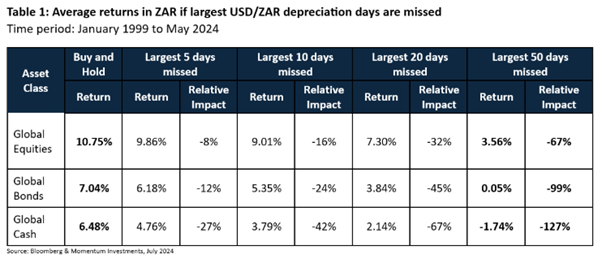
To quantify the potential downsides of timing currency movements, we analysed the impact of missing critical rand-dollar days on different asset classes from January 1999 to May 2024. By examining the effect of missing the largest 5, 10, 20, and 50 days of weakening and strengthening, we see the consequences of getting the timing wrong.
Weaker days: Missing the top 50 days of rand-dollar weakening results in severe return losses. Global equities drop from a 10.75% buy-and-hold return to just 3.56% (a 67% decrease), while bonds lose nearly all positive returns. The effect on cash is even more dramatic, resulting in a drop of more than 8% in absolute return on an annualised basis, effectively returning negative returns from global cash in rand terms.
Stronger days: Avoiding the top 50 days of rand strengthening benefits investors in all asset classes. For example, global equity returns increase by 49% and bonds by 72% over buy-and-hold when these days are missed.
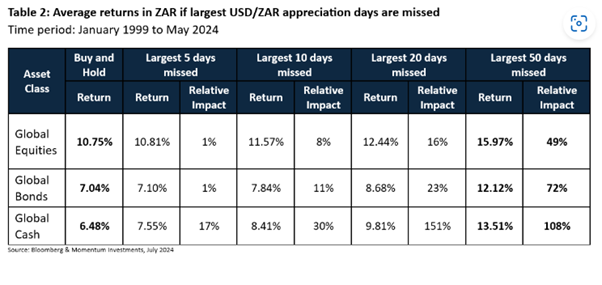
The asymmetry between missed weaker and stronger days shows the difficulty of timing currencies. Missing a few key days can severely affect returns, underscoring the dangers of speculative currency timing.
Testing trend-following strategies
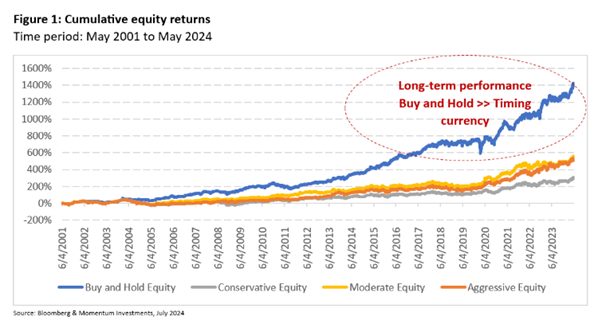
Some investors implement trend-following strategies. We tested this approach across three investor profiles — Conservative, Moderate, and Aggressive — to assess performance against a simple buy-and-hold strategy. We assume that these different investors switch different allocations of their assets into the weakening currency, backed by a trend-following approach based on different thresholds.
- Conservative investor: We assume that they adjust 30% of their portfolio if there’s a 10% change in the rand-dollar exchange rate over a three-month period. This strategy’s high threshold for switching minimises transactions but risks longer periods of suboptimal allocation.
- Moderate investor: They attempt to balance risk and opportunity, switching to 50% after an 8% exchange rate change.
- Aggressive investor: We assume that they move 100% of their portfolio on a 6% currency shift, aiming to capitalise on rapid changes.
As illustrated in figure 1, a buy-and-hold approach consistently outperforms these active timing strategies, achieving higher returns with lower volatility and fewer drawdowns.
In fact, regardless of the investor profile, the evidence suggests that actively timing currency based on trend signals does not improve returns relative to a stable, long-term approach.
Why a buy and hold approach wins
For most South African investors, a buy-and-hold approach focused on long-term asset growth rather than short-term currency fluctuations will be more likely to yield more stable returns. As difficult as it may be to ignore daily exchange rate movements, the data shows that focusing on a long-term strategy provides both peace of mind and greater growth in outcomes. The temptation to time the currency may be strong, but for most, the wisest path is simply to stay the course.