Morningstar Behavioral Research
Introduction
People often seek a financial advisor to assist with a specific financial need, but is that the only factor that motivates someone to hire a financial advisor? In other words: Do we evaluate financial advisors on their ability to accomplish a specific financial need, or do we consider other qualities of an advisor when making hiring decisions? In our research, we dove into understanding what motivates a person to hire a financial advisor. Although we see the expected importance of seeking an advisor to address specific financial needs, we also found more emotionally based factors can contribute to hiring decisions.
Summary of findings
- Overall, we found people chose their financial advisor for numerous reasons—not just to help with a specific financial issue. Particularly, participants indicated the influence of other factors such as their own discomfort handling financial issues and the desire to get help in making good decisions and staying the course (that is, behavioral coaching). These findings suggest it is important for advisors to lead with their ability to provide both financial and emotional support when courting new clients.
- Our findings suggest people are motivated to hire a financial advisor because of reasons pertaining to client discomfort handling financial issues as often as they hire one because of reasons pertaining to a specific financial need.
- However, new clients may not always be willing or able to express the emotional needs they are hoping a financial advisor can meet when seeking one out. Still, advisors can address these emotional drivers by demonstrating to prospective clients the ways in which they can address both financial and emotional concerns in a research-backed way.
Hiring is more than a numbers game
Why a person hires a financial advisor may seem like a simple question at first. In addition to advisors’ reported experience, research on the topic tends to confirm that people seek out financial advisors to deal with specific financial issues such as retirement planning, receiving a windfall, increased income, and more. As such, it can seem like a forgone conclusion that the decision to hire a financial advisor is driven by a person’s specific financial needs. However, handling specific financial issues is not the only way that financial advisors contribute value to their clients; the behavioral coaching advisors provide contributes demonstrable value to client outcomes, too. Moreover, financial advisors are found to provide better emotional support (for example, peace of mind) than robo-advisors. Despite these benefits, people often view the financial support advisors provide as more valuable than the emotional support. As such, an open question is whether hiring decisions are driven by just financial concerns or whether emotional concerns also serve as motivators.
“Please list some reasons why you hired your advisor…”
To better understand what motivates hiring decisions, we asked people who currently had an advisor to list some reasons why they hired them. The question was open-ended, allowing us to collect people’s thoughts in their own words. We featured this question in three different surveys, which included a total of 3,003 people, conducted during specific periods of 2021 and 2022. We were able to collect 623 responses from people who indicated that they currently had an advisor. We randomly selected 312 responses (half of the data) for manual analysis.
As part of the analysis process, we examined existing research to identify common motivations behind an persons decision to hire an advisor (Exhibit 1). These motivations can be further categorized as to whether they are related to strictly financial factors (cost, performance, specific financial needs) or to more emotionally driven factors (comfort, trust, guidance). Using this master list of common motivations, we manually categorized responses into one or more motivation categories based on the topics a person mentioned in their response.
Exhibit 1: Common motivations behind hiring decisions
| Emotional | Financial | Other |
| Discomfort handling financial issues
Advisor was hired because of the client’s lack of confidence in their own skills needed to reach their financial goals or their knowledge regarding finances. |
Specific financial needs
Advisor was hired because the client had a specific financial issue that needed to be resolved such as planning for retirement, handling the loss of a spouse, or tax planning. |
Moved away
Advisor was hired because the client or former advisor moved away and were no longer local. |
| Quality of relationship with advisor
Advisor was hired because the client felt they could have a good relationship with their advisor owing to any number of factors such as a match in values, having trust in the advisor, and having a good rapport. |
Quality of financial advice and services
Advisor was hired because their financial services were perceived as being able to help the client achieve their financial goals. |
Emotion-related reason
Advisor was hired because the client had an emotional issue otherwise not categorizable. |
| Quality of communication with advisor
Advisor was hired because client liked the communication they had with their advisor regarding financial services. |
Returns or performance-driven factors
Advisor was hired because the client expected they would see the return performance they wanted. |
Finance-related reason
Advisor was hired because the client had a financial issue otherwise not categorizable. |
| Self-presentation of advisor Advisor was hired because of how they presented their business (for example, office, staff, and so on) to their client. | Free to me
Advisor was hired because their services were provided for free. |
|
| Recommended by friends/family
Advisor was hired because client was encouraged to do so by trusted individuals. |
||
| Behavioral coaching
Advisor was hired because they could provide sufficient support to help the client act in a way beneficial to their finances such as explaining the financial plan, motivating the client to stick to the plan, or providing guidance on what not to do in certain financial situations. |
||
About the survey
It’s important to note that the survey environment provided a unique opportunity to get to the heart of why someone hires a financial advisor. Participants were able to take the survey in the privacy of their own home and at their own pace, allowing them to think carefully about their answers and respond without any social pressures. This environment may make respondents less susceptible to social desirability bias, the tendency to respond to a question in a way that conforms to societal norms and preserves standing. In the real world, people may provide more “socially acceptable responses” when meeting with an advisor in person (such as needing advice when managing a retirement account) because they are speaking directly to an advisor and/or because they are accompanied by their spouse/loved ones. Addressing a person’s motivations separately may provide an unvarnished look into what drives people as they seek advice.
Who hires a financial advisor?
Of the 3,003 people who answered one of the three surveys, only 623 reported they currently worked with a financial advisor—roughly 21% of the full sample. In the US, about one third of Americans report working with a financial advisor, yet 62% report needing to improve their financial planning. In the UK only around 11% of adults have paid for financial advice in the past two years. The US numbers demonstrate that there are a number of people who would benefit from working with a financial planner but do not yet do so, and this points to the importance of understanding what factors compel people to hire an advisor in the first place.
We examined demographic variables to determine whether there were differences between those who hire a financial advisor and those who do not. Given that a certain level of asset ownership is a limiting factor for having a financial advisor, we compared just those who reported at least $50,000 in investable assets (N = 1,574). We found that individuals who had hired an advisor had higher income, had a higher amount of investable assets, tended to be older, and on average had more experience investing than those without. In our sample, we also found a greater proportion of women reported having a financial advisor compared to men (34% versus 28%), and a greater proportion of white participants reported having a financial advisor compared with nonwhite participants (32% versus 23%). Those who had a financial advisor were as likely to think they were an investor as those who did not, and both groups reported equivalent levels of investing expertise.
Research methodology
We began our analysis by reading through each response and identifying which categories were mentioned in the response. Two human raters completed this part of the analysis. To ensure that the human raters were categorizing responses in a consistent and aligned manner, we first established inter-rater reliability with 20% of the sample before proceeding. Each response could be placed into more than one category. For example, the response “1. To explain the complexities of it all. 2. To help me maximize my assets 3. to save me time and worry 4. to save me taxes 5. to sell me insurance” incorporates multiple categories. The respondent notes that they went to a financial advisor for help with their taxes and insurance needs, which fits under the Specific financial needs category. They also mention they hired an advisor to “explain the complexities of it all” which fits under the Behavioral coaching category and speaks to an advisor’s role as a teacher. Lastly, their reference to an advisor saving them “time and worry” fits under the Client comfort/discomfort handling financial issues category.
Why did participants hire their advisor?
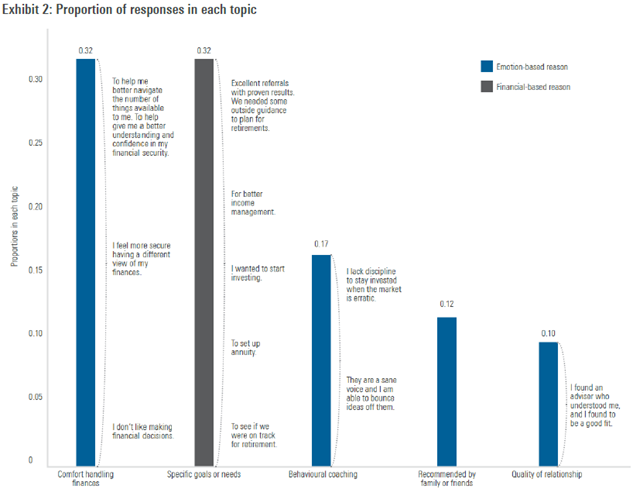
After categorizing each response, we examined the frequency with which participants cited each reason (that is, what are the most common reasons for hiring an advisor). The two most-cited reasons given for hiring an advisor were Discomfort handling financial issues (32% of responses) and Specific financial needs (32% of responses). Participants also commonly cited Behavioral coaching (17%), Recommended by friends/family (12%), and Quality of relationship with advisor (10%). See Exhibit 2 for the five most common reasons for hiring an advisor with examples. The bars in the exhibit are color-coded by whether the motivation can be traced back to an emotional- or financial-based factor.
We found clients hired their advisor not just because they were looking for assistance with a specific financial problem. Indeed, they more often listed an emotional reason (60% of responses) than a financial reason (40% of the time) for hiring a financial advisor. This suggests that although financial issues certainly are a common driver of client hiring decisions, there is an additional thread of emotional drivers—like the degree to which someone feels comfortable making financial decisions and their ability to stay the course.
Conclusion
Our research suggests that addressing a specific financial need is only one of many potential reasons someone hires an advisor. We find that some emotional-based factors may play a large role in hiring decisions. Although it’s not too surprising that people go to a financial advisor to address a specific financial need, it may be surprising that they go to an advisor to address an emotional reason—their discomfort handling finances themselves—to the same degree. For advisors, this means they must acknowledge both financial and emotional drivers when meeting with a prospective client. Although addressing financial needs can be done in a straightforward manner, addressing a client’s emotional needs must be done in a tactful and subtle way. To help advisors incorporate these insights in their practice, we created a three step exercise (on the following page) that advisors can use when formulating their first talking points with prospective clients.