Initial Reaction of the Rand to Trump’s Victory
It’s not biZARre, nor uncommon that we South Africans have a thick skin when it comes to our rand tanking when anything seismically political or any economic change comes into play. Some have thicker skin than others, but the rapid decline in our exchange rate is not an uncommon occurrence, not more uncommon than England winning the Rugby World Cup.
Since the US election and Trump’s victory on 6 November 2024, the rand weakened significantly, dropping by over 3% to around R17.81 against the US dollar.
Following the announcement, the rand weakened significantly, dropping by over 3% to around R17.81 against the dollar. The volatility in the rand impacts South Africa’s economy in various ways.
A weaker currency makes imports more expensive, which is a fundamental driving force of increased inflation – of which the SARB’s Monetary Policy Committee (MPC) stringent policies consistently navigate measures to maintain the inflation rate to be within its range. We can confidently say that we are winning on the inflation front, with inflation resting around 3.80% for September.
Although the rand is seeing a dive, the positive outcome of this is that it boosts competitiveness for exporters, particularly in sectors like mining and agriculture, where South Africa’s commodities are priced in dollars.
A few weeks into the new US presidency, the rand has steadily hovered over the R18/$1 level since 12 November.
Some investors can withstand the disruption in the exchange, some cannot be due to having their life savings invested in portfolios that are currency sensitive (i.e. living annuities and offshore pensions).
The chart below shows the sharp decline in our ZAR’s value since the US election results
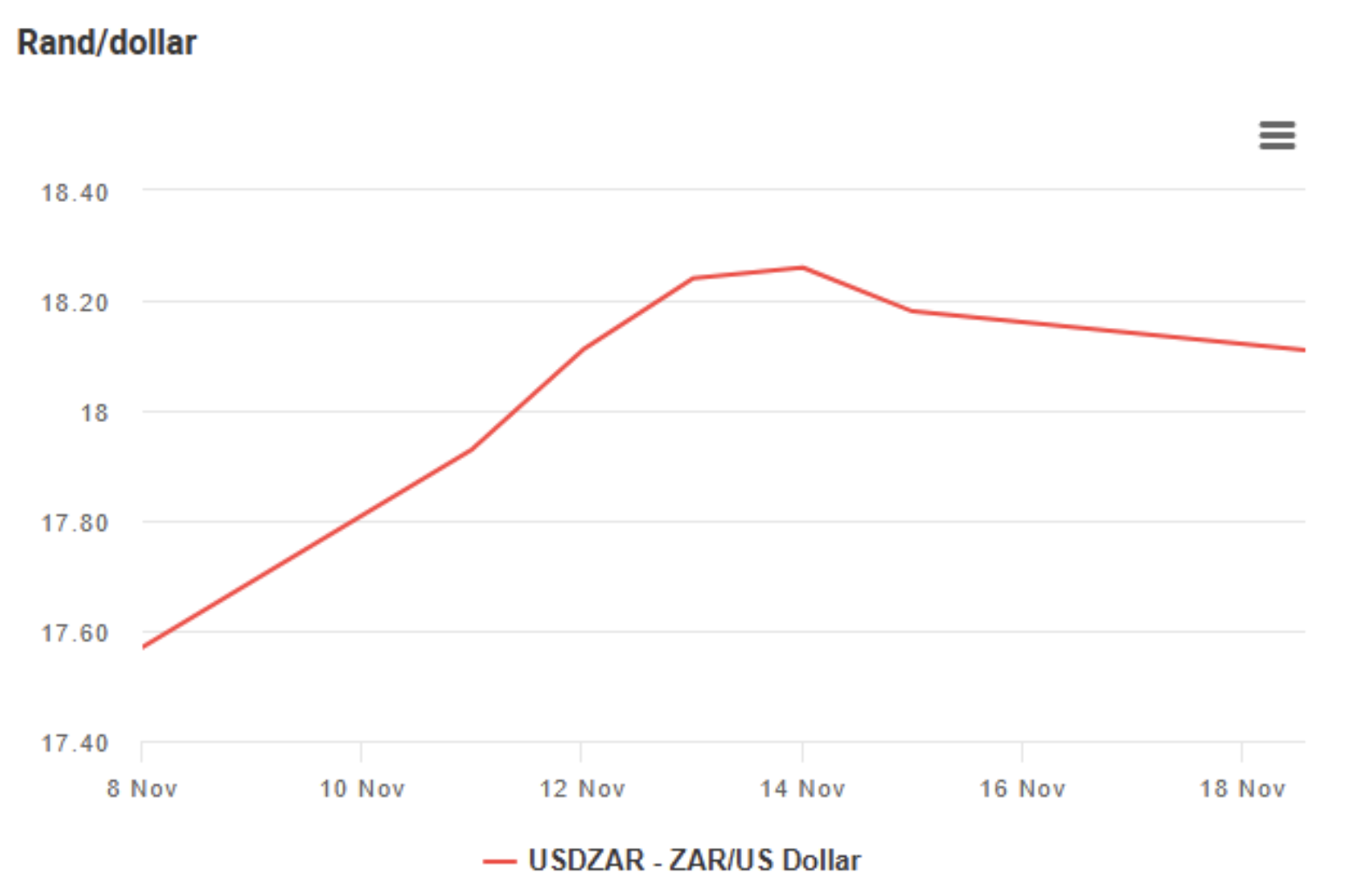
Source: https://www.moneyweb.co.za/news/markets/rand-hits-r18-to-us-dollar/
Simply put, what does this mean for your investment portfolios if you have local and offshore exposure?
From an offshore portfolio perspective, depending on what your underlying asset allocation is, it is vital to look at your portfolio value in two ways:
- Has the NAV (net asset value) of your investment grown? In other words, has the value of your share, ETF, unit price gone up? For example, has the price of your share gone from $100 to $110?
- From a currency perspective, has the weakened ZAR contributed overall to your portfolio value? For example, if your share went down from $100 to $90, but the ZAR depreciated by 3%, has your portfolio in affect grown?
Investors should not only view their investment portfolios through the eyes of the Rand/Dollar exchange but also look at their overall NAV as well as the currency.
From a local viewpoint, the cost of having direct offshore exposure has now become more costly than a few weeks ago.
What this means is for a dollar per rand, it will cost you more to externalise your funds – thus buying you fewer dollars for your rands.
We are of the view to not time the market, however, being exchange rate sensitive and having the tools in place to accurately secure a favourable exchange rate – allows investors to choose when they would like to pull the trigger to exchange their ZAR.
The Local Economic Impact and Trade Implications
The impact Trump’s victory will have on our local economy filters through into the performance of your funds, in one way or another, even if the underlying assets are not directly correlated to the US.
We have strong agreements in place with America namely the African Growth and Opportunity Act (AGOA), which supports over 13 000 South African jobs as well as a long-standing export agreement to the US.
To keep matters simple, the US has a finger in all pies – and with SA having the potential to (1) lose jobs and, (2) export demand to the US to vastly decrease ultimately affects our economy. In turn, this affects our local businesses and investor’s underlying investments if they are exposed to factors such as the above.
But let’s not panic. The AGOA is still in place and has a meaningful purpose between RSA and the USA that supports our economy. Additionally, if the AGOA ever had to fall away, we are likely to make up the loss in tariff discounts with the weakening of our rand.
From an import perspective, if only the picture below was Oprah shouting, “You get a car! You get a car!” to all emerging markets, it would add hope to trade partners and US voters who have openly voiced their concern over Trump’s victory and his 34-count felony convictions.

In fact, it’s Donald Trump on stage in Florida accompanied by his office advisers, party leaders, family and friends. Alas, no emerging markets are getting free cars.
The Resilient South Africa and the MPC’s rate cut decision
On the bright side, South Africa’s credit rating by Standard & Poor has been changed from stable to positive. This can only have positive outcomes for us – despite our rand taking a beating, there will always be a way our economy and South Africans can bounce back from these knocks.
The SARB cut rates by 0.25% at its recent Monetary Policy Committee meeting and has forecast a 2.7% economic growth for the next two years. Industry players in the market are of the opinion that the SARB will cut rates by a further 0.25% in 2025, possibly each cycle at a time. This can have enormous relief on investors whose balance sheets are debt heavy.
The decision made by the SARB, again, shows how resilient our economy and nation can be – to ride out the troughs that we are used to previously experiencing. These trends are not new to us.
In the coming months, it will be critical to determine how South Africans adapt to all these economic changes, balancing domestic priorities with the realities of an evolving global landscape.
In summary, these are a few things to focus on whilst blocking out the noise:
- Our S&P rating adjustment to positive will only enforce an increase in foreign direct investment.
- Our SA bonds have become attractive to overseas investors, with a spike in our bond yield up to 9.66% on a 10-year SA Government bond.
- Our interest rates have been cut, providing relief to debt-heavy households.
- Depreciation of the rand has a positive effect on our trade surplus i.e. the value of our exports will subsequently increase.
- We are still the #1 Rugby Team in the world 😉
Whilst riding through the troughs and Triumphs, at Resolute Wealth Management we continue to focus on consistently growing and protecting our client’s wealth amongst the ever-changing economic and political landscape.